
Today, I’m at LILAC Conference 2022 (@LILAC_conf), which is taking place at Manchester Metropolitan University. In advance of the event, we were asked to book the sessions we would like to attend. So, for the next three days, I will be discussing the highlights of each workshop and talk that I attend. You can follow along as each day goes on, or read in full at the end of the day. Here’s day 1:
Session 1: Breaking Out of the Library Bubble – Information Literacy and Curriculum Alignment
Presenter: Louise Minta
Co-Presenters: Nicola Gregory (@PurpleSmile) and Emma Thompson (@LibraryEmma)
Nicola and Louise gave a brilliant insight into their Information and digital fluency framework, which was in the making over the past few years. A main point they made was that to develop a framework like this, and for it to be relevant and usable for the university as a whole, they needed to speak the language of the university. They did this by aligning their framework with what the university wanted to achieve. Information literacy should be part of the curriculum – but you need to be in the position or have a situation where you can make that happen, so having clear communication and visibility of what you do can really help.
Food for thought for me after this session was:
How do you develop a flexible framework that can work for HE, FE, Access to HE, and Supported Learning? Should they be separate?
Also, how do we include employability in the teaching/framework? Should we?
Session 2: Increasing Inclusivity – Developing a HEA Accredited Teaching Course for Librarians
Presenter: Kirstie Preest (@KirstieWales)
Co-Presenter: Meg Westbury (@MegWestbury)
A lot of us in libraries don’t get formal teacher training – even if you do, it might be an optional module or a bit adhoc (for me, I did a module in elearning as part of my library MA, which did cover teaching theory and pedagogy, but it may still inevitably leave gaps of knowledge).
This talk discussed the process of a Teaching and Learning course which has been designed for librarians. This process started in 2013, and it is still in progress. In 2019, they were ready to launch a 9 month blended learning course, but the pandemic put a spanner in the works and they had to pivot to online. They later found that moving the course online actually increased inclusivity.
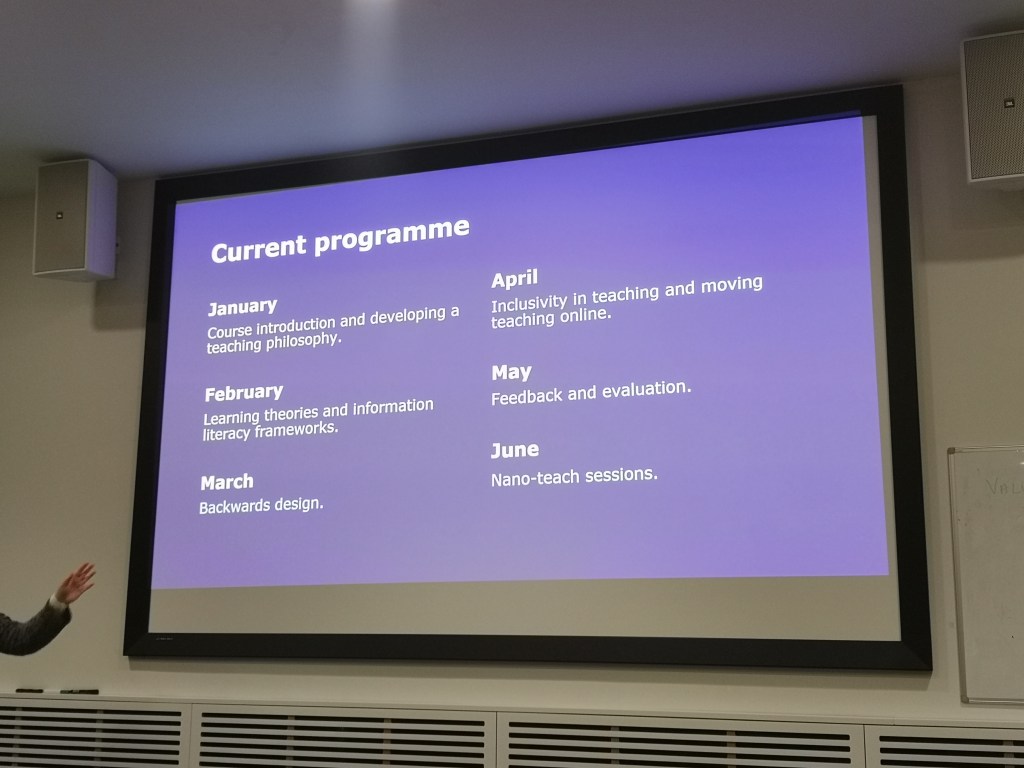
In 2021, they launched a 6 month online course, and are currently on their second cohort. They use a number of online applications to deliver their lessons (Teams, Zoom, Padlet etc) and are still learning through teaching the course. Though all the paperwork is complete and ready, they need to wait another 3 years for the course to be accredited.
Keynote: Student Panel
- Susan Connor
- Ray Smith
- Imogen Webb
- Rachel Wilding
This session gave a real insight into the individual students’ opinions on a number of topics, ranging from burnout and wellbeing, to GDPR and library stereotypes, to social media and librarianship as a caring profession. Ray Smith discussed how you can feel less alone if you have a wider community – such as the IL community of practice (LILAC) to speak to. Susan Connor gave evidence that turnover of staff costs real money – that should be reason enough for a corporation to have strategies in place that consider their staff’s wellbeing. As Imogen Webb correctly pointed out, most of us are not wellbeing experts. We are susceptible to burnout, and Susan Connor suggested that a lack of understanding of what we do within this profession can lead to a lack of recognition. This can lead to invisible labor. Rachel Wilding echoed that root causes of burnout are that we are overworked and underpaid (I definitely won’t disagree with this).
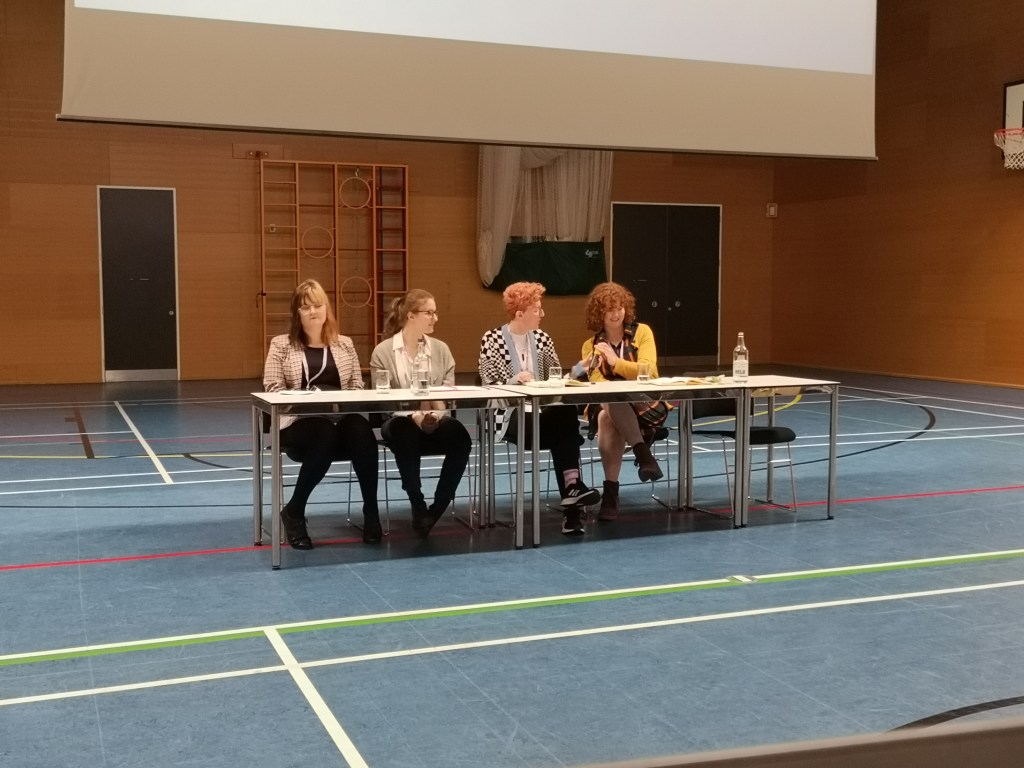
On the topic of library stereotypes, Ray Smith made a really interesting point of: ‘how can you go into a job if you don’t know what it entails?’ We’ve been told that there is a skills gap and CILIP have said for the past few years that there will be a large group of workers retiring in the near future – how do we fill this gap? Especially when the general public don’t really understand what the roles are within libraries and knowledge management? How do we attract new professionals if it isn’t clear what they’ll be getting in to?
The whole group were surprised at the lack of guidelines for library staff who manage social media for their library. As an ex-digital marketing consultant, sadly this doesn’t surprise me at all. Social media has always been an underappreciated and misunderstood skill – even in B2C companies. Though having a crossover between two teams: a specialist media team and the library team, would be difficult to put into reality in most companies and institutions. They are separate both structurally (within the organisation) and physically (within the company building), and library social media is not seen as a vital output for communications teams, to the extent where it deserves its own accounts. It really depends on the library, and the size and responsiveness of their audience, what would be right for them.
Session 3: Factors that Impact the Relevance of Information Literacy to College Students – The Kaleidoscope Effect
Presenter: Karen Kaufmann (@LiteracyFan)
In this session, Dr Karen Kaufmann discussed her doctoral study, and the subsequent development of 9 key factors and 11 dimensional factors of the relevancy of information literacy. The primary research question for the doctoral study was: How is information literacy relevant, from a socio-cognitive user view, to undergraduate student academic work?
In the study, information literacy was found to be perceived by students as socio-cognitively relevant – or useful and meaningful – when used for an academic assignment and their academic work generally. It was interesting that students also recognised the relevance of information literacy when placed in the context of their real world (how IL can be used in the real world, and how it is connected to things external to their academic study.
Applying information literacy skills to their academic work involved meta cognition (thinking about one’s thinking) and the kaleidoscope effect (how students’ perceptions and how they think, can change every time a new experience happens, or they learn something new).
Threshold concepts theory also came into play (crossing thresholds of understanding and liminal spaces – in one area IL, and in the other their subject). There are lots of processes of understanding knowledge, depending on the knowledge base, which can also be affected by many different factors (family heritage, social and cultural factors).
This talk was incredibly complex and I am sure I will still be thinking about it in weeks to come.
Session 4: Teaching Data Visualization as a One-Credit course
Presenter: Tatiana Usova
Data has become a commodity. Data literacy and digital literacy/fluency are now named as skills or core competencies that are in demand in the workplace and in educational settings. It’s one thing to understand data, but how do you communicate it? Visual communication, like infographics is one of the quickest and easiest ways to communicate data. However, data visualisation literacy requires literacy, data literacy, and visual literacy – it asks a lot of us.
This talk covered the development of a one-credit course on data visualisation, that covered areas as foundational as what data is, and the history of data, to where to look for data, storytelling with data and how design principles can affect the usefulness of some data visualisation. Similar to web design and app design – if the design for communicating data is colourful and beautiful, but isn’t user friendly or intuitive, a user can not make sense of anything. It isn’t useable or accessible.
But more importantly, or at least more relevantly to librarians, how data is presented can be biased, as it can be informed by an agenda. This knowledge is imperative for understanding when data may be misinformative or disinformative. Especially so in a data-driven and oversaturated world.
You can read the full article in Volume 15 in the Journal of Information Literacy.
Session 5: Tailoring information literacy instruction using the information discernment diagnostic questionnaire
Presenter: Geoff Walton (@GeoffWaltoniLit)
Misinformation and disinformation have been around for a long time, but due to the speed at which information currently spreads, we know that now more than ever, we need to ensure that people have the ability to tell when something is fact, and when it isn’t.
In this session we discussed an information discernment questionnaire designed by Geoff Walton based on previous questionnaires, which focuses on the psychological elements that affect our understanding of information. This questionnaire would be used with students to better understand their ability to assess information, and included questions that looked at motivated reasoning, confirmation bias and epistemic beliefs.
A very useful session and questionnaire, that would be a great starting point for understanding your students’ current knowledge state. This could then in turn, inform sessions that you may do in the library on information literacy.
Session 6: Teaching how to structure literature reviews via 1990s movies
Presenter: Kirsty Thomson (@Kirsty_Thomson)
This was a popular session that quickly booked up, and in hindsight I’m not surprised. It was a brilliantly fun session on how to make the teaching of literature reviews more engaging for students of all ages in a way that they will easily comprehend. These classes can also work in person or online.
In previous sessions on literature views, Kirsty had found that students were able to find sources for their work, but they didn’t know how to work this into their assignments.
This style of teaching how to structure literature reviews, included groups of students working on summaries and themes for three common films: Titanic, Jurassic Park and Romeo and Juliet. Though it could work with other films or possibly even music.
I already know that I will be trying this out soon in our literature review sessions! Thank you Kirsty!
The End of a Long and Fruitful Day
The first day of LILAC 2022 is over, and now I’m off home to eat some pasta and tell Andy and my cat, Lupin all about my busy day. Until tomorrow, when all this starts all over again!


 Nicola Semple
Leave a reply to Mike Sivori Cancel reply