
Welcome to day two of my live highlights of the LILAC Conference 2022. Today is the second of three days where I am attending LILAC Conference 2022 (@LILAC_conf), at Manchester Metropolitan University. In advance of the event, we were asked to book the sessions we would like to attend. In this post, I will be discussing the highlights of each workshop and talk that I attend on day 2. You can follow along as the day goes on, or read in full at the end of the day. If you missed day one you can read all about the sessions I attended in the LILAC Conference Day One blog post. Otherwise, here’s day two of LILAC 2022:
Keynote: Marilyn Clarke
In this keynote, Marilyn Clarke discussed the process of decolonising the collection/curriculum at Goldsmiths. The students drove this change, and the library questioned what they could do as a part of this. One of the most interesting, and potentially powerful, decisions they made was to set aside some money specifically for student suggestions, asking the question: whose voices are missing? A former member of staff created a book plate that would identify when a book was bought as part of this student-suggested collection. Some of those student suggestions have also made it onto reading lists.
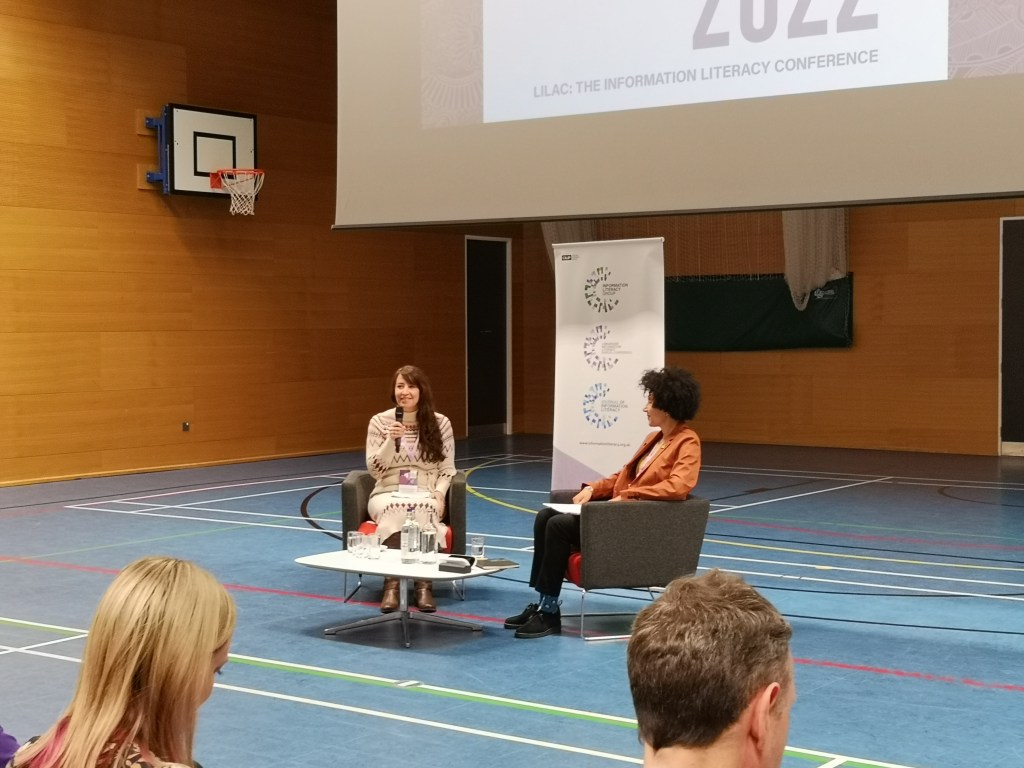
The audience at LILAC were asked to send in questions for Marilyn, and these covered the topic of decolonisation, as well as diversifying collections, the publishing industry, librarians’ role in the process of decolonisation and open access.
Marilyn explained that decolonisation is about context; thinking about history and why voices have been and are excluded. With diversification of collections, this indepth consideration may not happen in the same way. When asked about decolonising a reading list as a standalone activity (one subject within a programme) Marilyn suggested that if we’re not looking at the programme/module/teaching as a whole then it isn’t truly decolonised. It should be a conversation for everyone. You should collaborate with every area of academia and the conversation has to go beyond the reading list.
As we weed, take stock of our collections, and acquire new resources for the new academic year, we have the opportunity to use this time to really assess what we want to achieve as academic librarians. It’s time for open discussions with other academic staff about where we are going, and what we want students to take from their learning as a whole.
Session 1: A Wolf in Sheep’s Clothing: Genre Blurring and Fake News
Presenter: Joel Burkholder and Kathleen Phillips
Disinformation is when information is shared with the goal of misleading while pushing a particular political agenda. This session looked at the psychological processes that come into play when people share and read information online. Genre confusion is the strategic borrowing of conventions associated with authoritative genres to increase perceptions of authority and credibility.
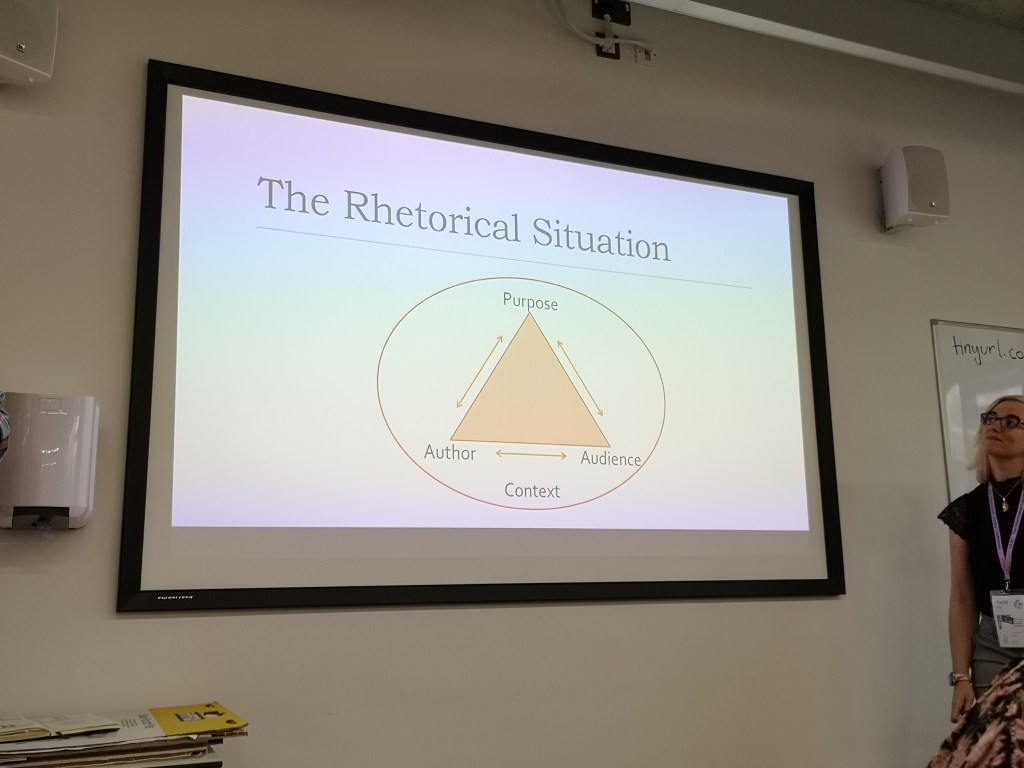
Fake news isn’t the only thing that uses genre confusion, satire / parody (The Onion), advertising and political campaigns all use conventions to increase perceptions of authority and credibility for a number of purposes. They may use logos (logic), pathos (feelings) and ethos (character) to create credibility.
Joel and Kathleen developed a process (and an acronym) called ‘IF I APPLY’. This involved personal and source steps that people can use to assess information, but not necessarily as a checklist. The most important factor about this process was that if you are assessing an element of a source such as an author or a publisher, it is not so you can mark something as wrong or right, but more to show that there is a process of reflection.
Being presented with disinformation can be incredibly confusing, and a lack of metacognition, can affect this further. For instance:
Emotions – anger, sadness, happiness can affect how you evaluate information
Overconfidence – “I did all of this research so I am correct”
Echo chambers – the more you hear something from multiple sources the more you start to think about it and buy into it
The clearest and easiest way to interrupt these is reflection. If you prompt people to slow down and reflect, they tend to look at the facts of the matter rather than going with their gut feeling.
Session 2: Supersize (and digitize) my session! Reflections on redesigning a small-scale workshop for a large-scale setting in-person and online
Presenter: Chris Thorpe (@CThorpe83)
This session discussed the process of adapting a workshop for quadruple the number of students than was initially expected. The workshop focused on evidence based practice – they wanted to improve student’s abilities to assess the credibility of information, in a way that would continue with them into their professional careers. At the end of the workshop they had the students complete an assessment in the form of a blog, that would allow them to show their understanding of image copyright.
They took advantage of the room layout, and the students worked in large groups and fed back to the class. A Swansea university LILAC session from 2018 suggested that you have a box of tricks – which included an array of teaching resources that could be grabbed and used at a moment’s notice. This came in handy in this workshop.
Chris and his team were planning on repeating this session the following year (2020) and as we all know, the pandemic happened. They had to take it online for a much larger group (100 students). Content was contemporised, as they were able to assess wikipedia pages and other sources that covered the topic of Covid-19. They were also able to use news examples to show how information can be interpreted differently.
The large student groups was replaced with breakout rooms for the online interpretation of this workshop. They also used a shared word document as it was something everyone would be familiar with. They found that online spaces were just as complicated as working with large groups in large spaces. You have to think about accessibility and engagement even more when something is online.
Session 3: Prioritising Inclusion and Equity in Information Literacy Scholarship: A Panel Conversation with the Editors of CIL and JIL
Presenters: Christopher Hollister, Meg Westbury Jacqulyn Williams, Merinda McLure
Scholarly publishing is biased, and it is exclusive. This session discussed how JIL and CIL have worked and are working to improve their inclusion and equity practices.
Changes made at JIL include:
Focusing on inclusive language and changing language that was ableist (blind peer review has been changed to anonymous peer review)
To address labour issues they now encourage authors to make all authors clear on articles.
They now allow changes to names on older articles (for any name changes someone may have had).
They now have board members from different areas around the world, to encourage diversity.
Content changes include –
Open data sharing – encouraging quantitative data sharing
Peer mentor scheme for new authors to provide more support for CIL
Open peer review system to make the process more transparent
Systems changes include:
Tom Peach is on the editorial board and has been thinking about accessibility, including improving the user experience for those who use screenreaders, and allowing for downloadable pdfs and word document of articles.
They are now also thinking about anti-racist development.
Session 4: Wikipedia, Student activism, and the Ivory Tower
Presenter: Ewan McAndrew
This session explored the ongoing discussion of Wikipedia’s reliability and its usefulness in academic research. Wikipedia is the 8th top site on the web in the UK and it is almost always shown at the top of every results page on Google. It wouldn’t be an exaggeration to say that it is the first port of call for many people, when learning about an idea, concept or piece of history that is new to them. So why is it such a dirty word in academia? Well, mainly, because it can be edited by anyone. So how reliable is it really?
Ewan McAndrew, is a self proclaimed Wikimedian – in other words, someone who edits wikipedia pages, neutrally and with citations that support the content they add. The problem with Wikipedia is that they aren’t enough contributors. It is a fantastic resource of collaborative knowledge, we don’t need to avoid it.
Ewan McAndrew holds monthly editathons to improve the diversity of articles on Wikipedia. In recent years, the percentage of articles specifically about women has risen from 15% to 19%. Minor, but it is something.
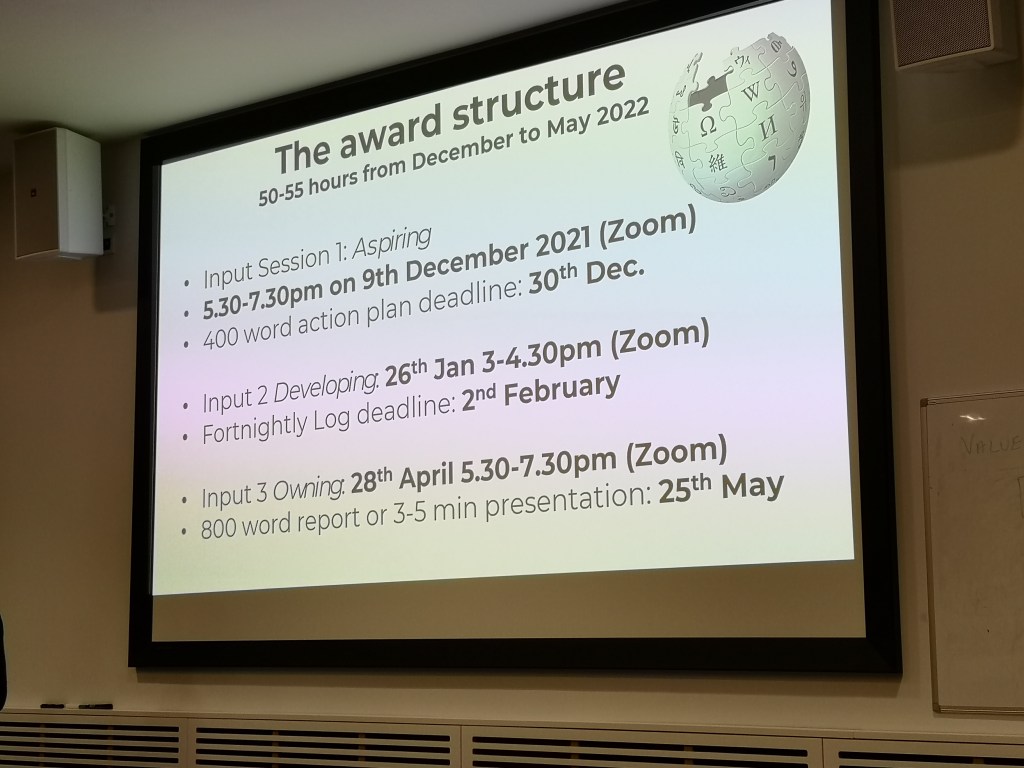
The Edinburgh Award is a way for students to receive professional recognition for the extra-curricular activities they do outside of classes. Their work in improving Wikipedia pages can get them a Digital Volunteering for Wikipedia Edinburgh Award.
Session 5: Designing Information Literacy materials using the student voice – building a self-directed, blended learning programme for Lifelong Learning students at the Institute of Technology Carlow
Presenter: Breda Connell
This session felt very familiar in a lot of ways. Breda was brought on to the library team at IT Carlow to provide support to students who had experienced non-traditional routes to HE. These students were time poor, juggling work study and had caring duties. Many were returning to education after a long time. They had no experience of the library as a place of study support. The current website didn’t feel right for them. They had many questions like – ‘how do I search for a book?’ and trying to access information was a huge barrier for them.
The many ‘why?’ questions could quite easily be linked to their non-traditional route to HE. Which highlights the issue that there is an assumption that people studying in HE, know everything they need to know to make the most of their study, before they even start.
The plan at IT Carlow was to do face to face library workshops, focusing on current assignments and topics, while also providing support from a distance. The initial visit to the students focused on getting back to the basics, like an introduction to things such as:
- The library resources
- Databases
- Searches
- eBooks
After a quiet few weeks, Breda returned and found that the students were still struggling. There was a call for funding, so she decided to submit a proposal and it was accepted. With this funding, she worked with the learning technologist to do research (a literature review of what was being done elsewhere for information literacy teaching), gather evidence, create content and then launch a VLE on the website and use modules for IL instruction.
The PACE Programme (Plan, Access, Critique and Evaluate) was modules that Breda created and were embedded into a VLE. The programme covered different elements that students needed to learn about the library and the library website. Videos were embedded into the VLE, such as those involving students finding physical resources such as a book from the library shelves. The programme is self-directed, and is also used by teaching staff as well as students, to familiarise themselves with the library service. It is constantly updated, and has had a more recent edition of a literature review module.
This may actually be one of my main highlights of the conference so far. The PACE Programme is forward-thinking and incredibly inspiring for me, as I’m constantly looking at how we may make the library a more accessible space, but also a space that students understand the purpose of. Especially those who are new to the HE environment and HE studies.
Conference Dinner
So another day is complete, and tonight we meet dressed up in our best at The Edwardian, Manchester, to have an evening of networking, food, wine, laughs and dancing. Until the headaches of tomorrow come to haunt us… But we’ll deal with that when we come to it!
 Nicola Semple
Leave a comment